
The business of online retail now relies on small efficiencies. What’s new no longer matters. Today, the bare minimum requirement for any online brand to persist is end-to-end e commerce automation.
At first, store owners wear all the hats. For example, they manage support, marketing, catalogs, inventory, and shipping all at once. However, as sales grow, handling these disconnected tasks becomes a drawback rather than a sign of success.
As a result, Instead of having employees manually enter order data into spreadsheets, you can automate. Manual workflows leave your company prone to errors and costly delays. Partnering with an AI automation agency like Remote Minion AI creates rapid efficiency across your operations. Cloud-based automation gives you a 24/7 asset that never takes a day off.

1. Reclaiming Lost Revenue with abandoned cart recovery automation
How Much Is Digital Window Shopping Costing You?
In fact, over 70% of online shoppers add items to a cart and then abandon it before checkout. That means 7 out of every 10 potential high-intent buyers express interest and disappear.
Most store owners try to fix this with basic, built-in email systems. These static templates usually send a single generic message hours after abandonment. Unfortunately, those delayed emails often land straight in the spam folder.
How the Automated Solution Works
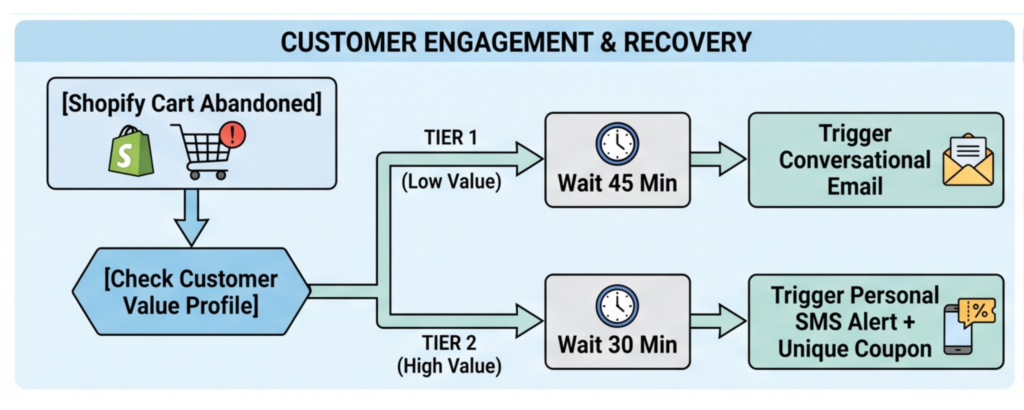
An optimized abandoned cart recovery uses a multi-channel strategy. It actively adapts based on user behavior on your website. First, an engineer connects your store engine (Shopify or WooCommerce) to Zapier or Make.com. Once the system detects an abandoned cart, a 45-minute delay initiates. First, this buffer window checks if the user returns to complete their purchase.
Next, the engine evaluates the cart value and customer profile history. For high-value purchases, the system bypasses standard email workflows. Otherwise, it sends the customer’s phone number to an automated terminal like Twilio. Twilio immediately delivers a personalized SMS containing a direct link back to their saved session.
Finally, the engine checks for engagement 24 hours later. It updates the customer profile inside your database. Then, it launches an automated email thread featuring a time-limited offer and a dynamic discount code.
2. Real-Time Stock Syncing via ecommerce inventory management & e-commerce inventory automation
The Unseen Price Tag Of Bad Stock Counts Manual updates on many sales channels?
Set yourself up for operational collapse. For example, imagine the havoc of simultaneously updating your stock levels across your online storefront, Amazon, and TikTok.
A sudden sales rush can cause accidental inventory overselling. This forces your support team to issue refunds, write apologetic emails, and handle negative reviews. On the flip side, over-ordering inventory creates different problems. Excess stock ties up your cash flow in expensive warehouse storage fees.
Create a Connected Data Hub
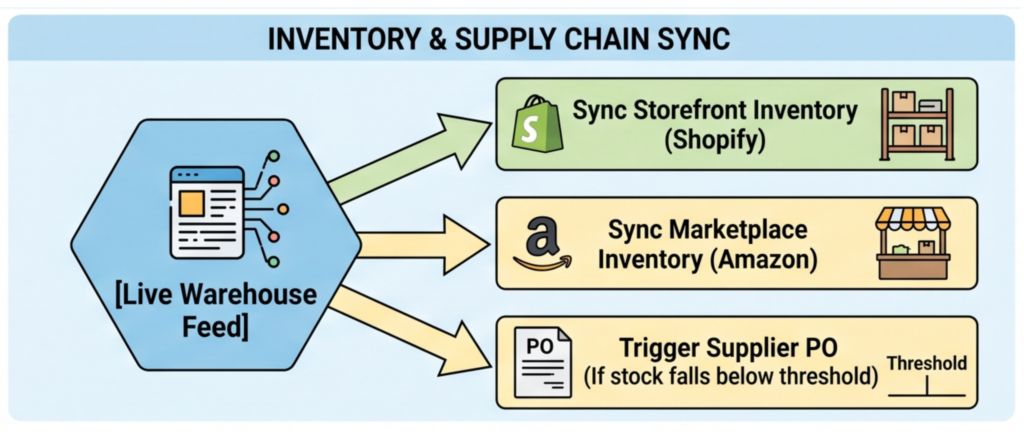
Modern e commerce inventory management relies on complete system integration. Effective store setups connect your sales channels directly to your stock management software. This creates one source of truth with live inventory updates feeding through to your various marketplaces. By replacing slow manual spreadsheet updates with e-commerce inventory automation, your sales channels become completely synchronized.
With simple visual data mapping, your warehouse software updates stock across all sales channels in real time. This ensures your inventory counts stay perfectly synced everywhere.
However, when stock runs low, a smart inventory script auto-generates a purchase order. It immediately alerts your supplier by email and messages your operations team on Slack. This completely eliminates manual tracking errors and prevents sudden stockouts.
3. Shipping from Order to Label with ecommerce fulfillment automation
The Warehouse Bottleneck
Customer satisfaction starts the moment a shopper clicks “Buy Now.” Furthermore, it continues until the shipping carrier scans the package tracking barcode. In manual operations, fulfillment teams waste valuable morning hours on tedious file transfers. Staff must download CSV files and edit column headings for systems like DHL or ShipStation. Next, they re-upload the formatted files manually. This waste of time delays daily orders significantly. Furthermore, address formatting mistakes open the door to costly delivery issues.
The Accelerated Fulfillment Pipeline
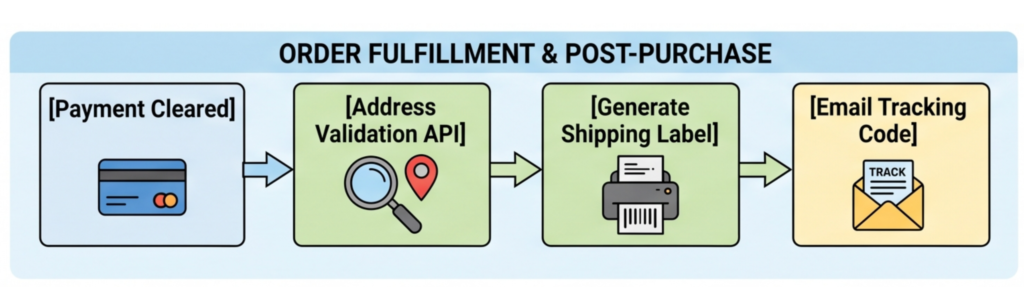
With an enterprise-level operation, ecommerce fulfillment automation accelerates your delivery pipeline down to mere milliseconds.
When an order passes your payment gateway, the system parses its details instantly. An address verification system catches errors right away. Next, the order payload automatically routes to your nearest warehouse print station or 3PL facility.
Within milliseconds, the system prints a packing list and shipping label. Staff pick the order, attach the label, and prep the package for carrier scanning.
Once created, the shipping barcode triggers an automatic API call. This passes the tracking number back to your store platform. The engine marks the order as “Fulfilled” and emails tracking details directly to the customer.
4. Upgrading Customer Support Operations via Custom ai automation agency Pipelines
Confronting the Day-to-Day deluge of Support Tickets
Rising order volumes quickly cause customer support queues to explode with repetitive inquiries. In fact, roughly 60% of incoming tickets ask the exact same simple questions. Customers routinely ask where their package is or how to start a return.
Why should your support team handle these basic questions?
Assigning routine queries to human agents inevitably prolongs response times. It also prevents your support staff from resolving complex customer issues.
Deploying Intelligent AI Agents
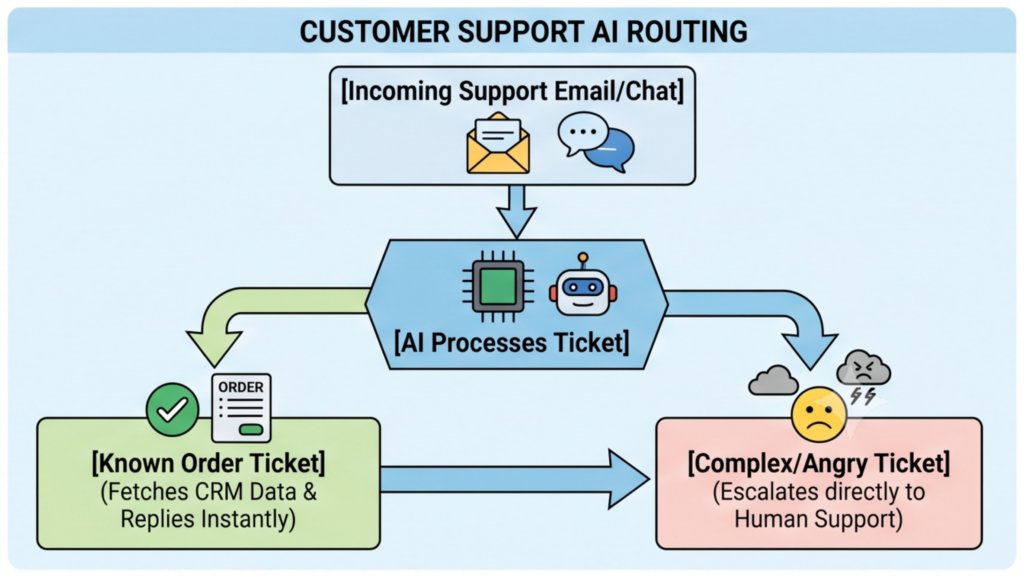
An expert AI automation agency solves this problem easily. They deploy smart LLM chatbots into support channels like Zendesk, Intercom, and Gorgias. When a customer messages in, the bot instantly scans the ticket to identify intent.
For order status inquiries, the AI pulls tracking data directly from your CRM. It checks carrier updates and sends a timely, personalized response automatically.
For returns or defective products, the AI evaluates the ticket details. It immediately elevates the message priority and routes the issue directly to a human agent.
5. Turning First-Time Buyers into Lifetime Fans with Post-Purchase Engagement Tools
The importance of Customer lifetime value
Profit rarely comes from a single online transaction. Rising digital ad costs often make the first purchase unprofitable. True brand profitability depends on customer retention and repeat purchases. Many brands ignore buyers once an order reaches its destination. Doing this means missing out on valuable customer touchpoints.
Designing an Automated Post-Purchase Journey

Smart Customer Retention Machine in Action:
For instance, real-time event updates drive highly personalized content during peak engagement. As soon as a provider marks a package delivered, sequence automation begins instantly. This automated workflow immediately nurtures lasting customer loyalty.
On Day 3, the system sends a welcome-back email. It provides product care guides or video tutorials to maximize customer satisfaction.
Next, on Day 10, the database evaluates the specific item purchased. Next, it then triggers an automated cross-sell campaign featuring a loyalty discount on related add-ons.
Finally, on Day 14, an automated review request goes out. High-scoring reviews prompt the system to encourage sharing on Google or social media.
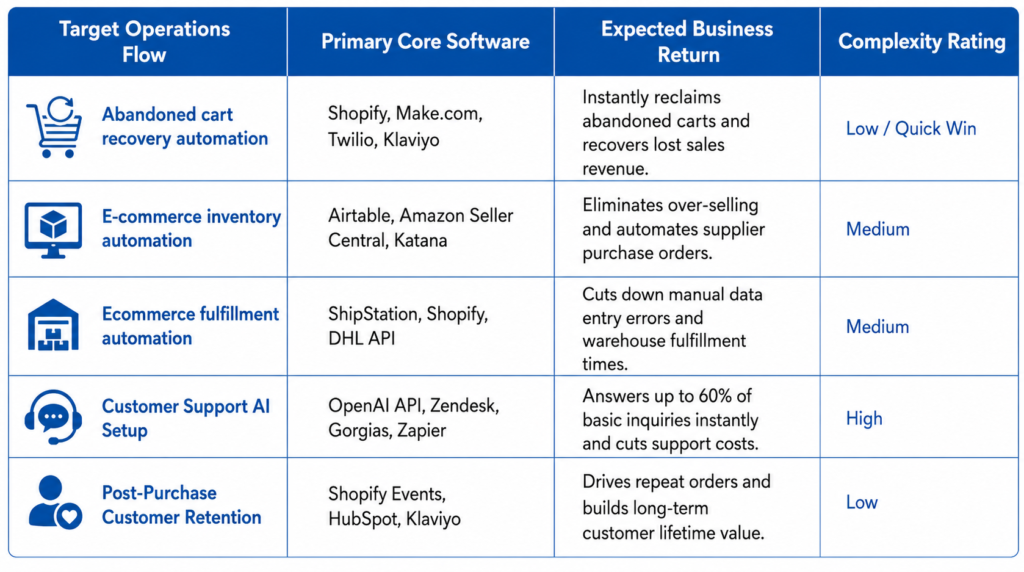
Strategic Summary Matrix: The e commerce automation Blueprint
To help your operations team prioritize these technical updates, here is a quick overview of how these operational workflows compare:
Taking Action: Transitioning Your Storefront to e commerce automation
You do not need to rebuild your technology to deploy your first automated workflow. Automating just one high-impact process—like abandoned cart recovery—yields rapid profit.
Eliminating initial manual tasks builds momentum quickly. From there, you can connect internal systems and introduce bespoke AI solutions to manage back-end operations.
Ready to replace messy spreadsheets, copy-pasted documents, and manual data entry?
Contact an executive AI automation agency like Remote Minion AI. We will audit your current systems, eliminate operational friction, and build custom enterprise architecture for rapid scalability.
Setting up administrative systems is only half the battle. You also need reliable teams to manage exceptions, audit inventory syncs, and handle back-office tickets.
If you want to test delegated support without committing to heavy contracts, learn why modern BPO outsourcing companies start with a $25/hour pilot program to de-risk your scaling strategy.
Frequently Asked Questions (FAQs)
Everything You Need to Know About BPO Pilots and Scaling Your Back Office
E-commerce automation is the use of software and AI-driven workflows to complete back-end, repetitive processes, like inventory syncs, order fulfillment, or customer correspondence-with little to no human intervention. The process essentially replaces time-consuming, manually run loops with automatic processes in the background-meaning less room for error and more time for high-value activities that will drive business growth.
No, you don’t need to be a developer. Most of the newer e-commerce automation tools come with visual interfaces called “no-code” or “low-code” platforms, such as Zapier or Make.com. For enterprise solutions or complicated integrations, it is more time-efficient to work with an ai automation agency, like Remote Minion AI, to build and manage your data pipelines.
High-impact, low-complexity “quick wins” is the way to start. Abandoned cart recovery automation is our most common “first workflow,” since you can reclaim significant revenue in minimal time. From there, you’ll want to consider more operational areas such as ecommerce fulfillment automation and AI powered customer support.
Yes! In fact, it is a huge enabler for scalability. The bigger your order volume gets, the slower your operations become-which ultimately stunts your growth. By adopting automated, “digital factory”-like workflows and integrating e-commerce inventory automation, you will have a machine that runs around the clock and can support exponentially more transactions without increasing administrative hires.
If your day to day consists of mostly data entry, copying information between applications, managing spreadsheets, or sending automated responses to repetitive customer service inquiries, it is time to partner with an ai automation agency. Your store has outgrown manual work. You are ready to transition away from disjointed task management into building a truly automated and scaled system.