
The business of online retail now relies on small efficiencies. It no longer matters what’s new, the bare minimum requirement for any online brand to persist is some sort of end-to-end e commerce automation. At first, store owners will wear all of the hats: customer, marketer, catalog management associate, inventory administrator, shipping manager and all in between. But eventually, as sales numbers grow, the practice of managing these disconnected operations become anything but a sign of your success, it becomes a significant drawback. Leverage a savvy ai automation agency, like Remote Minion AI, to create efficiencies in your multi platform operations that allows brands to quickly gain traction without incurring additional expenses.
Instead, having employees manually enter in rows of order data into spreadsheets, applications for fulfillment and lists for marketing, your company leaves itself prone to errors and delays. With cloud based automation, your operation gains a 24/7 running asset that never takes a holiday.

Over 70% of people using the internet will place an order into an online cart on an e-commerce store and then abandon their shopping cart before completing their checkout. Yes, 7 out of every 100 potential high-intent shoppers, express buying interest and then disappear on your site.
Most people try to remedy this issue by using a static, built-in email system found on the back-end of basic e-commerce theme software. These generic email builders usually trigger a one-time, generic message some hours after a purchase is initiated which ends up in spam folders anyway.
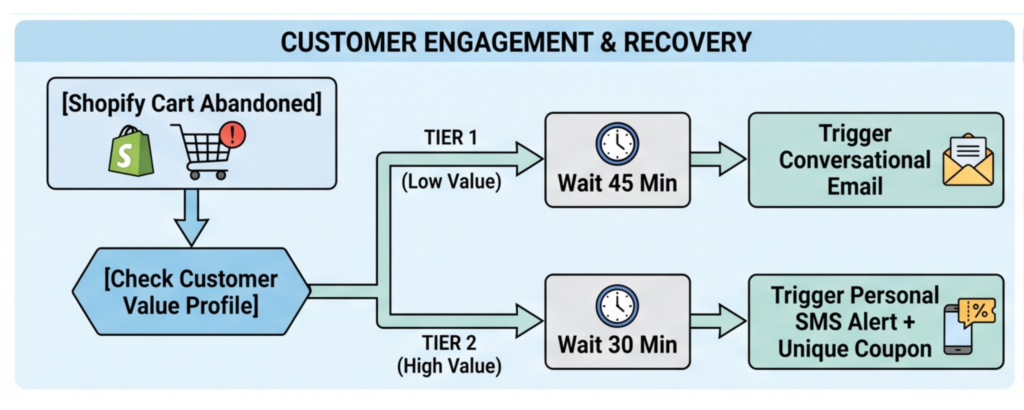
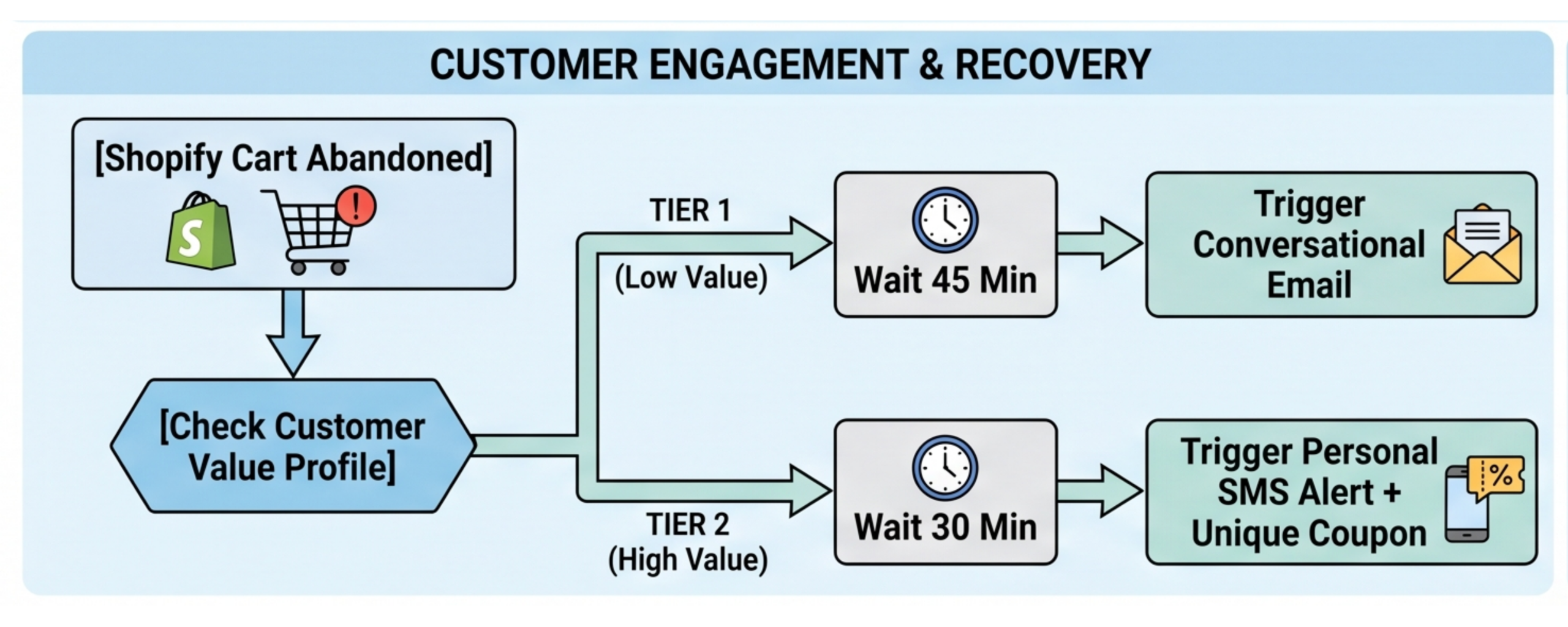
An optimized abandoned cart recovery automation process that involves a multi-channel strategy can actively change based on what a customer actually did on your website. An engineer will connect your store engine (Shopify or WooCommerce) into a cross-channel communication solution like Make.com or Zapier. After a cart abandonment has been detected by your engine, a script will initiate to delay the response by 45 minutes to see if anything changed.
The engine checks the checkout for any criteria indicating a high value purchase (like the total number of products) or high-value of customers in your database and bypasses any email, sending the user’s phone number to an automated terminal like Twilio and a personalized SMS message back with a link to their abandoned session.
The engine then checks 24 hours later to see if they engaged, updates any customer profiles, and then initiates an automated, back-and-forth email thread with an exclusive, time-limited offer with dynamic discount code.
Set yourself up for operational collapse. Imagine the havoc of simultaneously updating your stock levels across your online storefront, Amazon, and TikTok.
A rush on your marketplace could result in accidentally overselling a product on your website, forcing your customer support team to write apologetic messages, issue refunds and fend off nasty reviews.
On the flipside, if you over-order product to mitigate these risks, you end up tying your money up in costly warehouse storage fees.
The reality of modern ecommerce inventory management – when managed effectively – means your sales channels and stock management systems are fully integrated. This creates one source of truth with live inventory updates feeding through to your various marketplaces. By replacing slow manual spreadsheet updates with e-commerce inventory automation, your sales channels become completely synchronized.
Using simple visual data mapping, your warehouse management software or an overarching master inventory sheet pushes stock changes across all your sales channels in real time from your website.
And, when you’re running low on any given item, a smart inventory script can be programmed to auto-generate a purchase order to alert your supplier by email and simultaneously message your ops team via Slack on those critical “order this now” occasions – no more finger strain required.
When it comes to customer satisfaction, the shipping process actually starts when they click on the “Buy Now” button – and extends until your customer’s shipping carrier scans the barcode to their tracking information. In an all non-automated operation, members of the fulfillment department have a good portion of their mornings filled with downloading CSV files, editing column headings to fit the criteria in the carrier’s system (like DHL or ShipStation) before re-uploading it. This waste of valuable work time adds hours to each day’s orders and opens the door to numerous delivery issues due to address formatting mistakes.
With an enterprise-level operation, ecommerce fulfillment automation accelerates your delivery pipeline down to mere milliseconds.
The minute an order passes your payment gateway, its details are immediately parsed, its address is run through an address verification system to catch errors, and the order payload is automatically directed to your closest warehouse print station or your third party fulfillment (3PL) facility. Within milliseconds, a packing list and shipping label are printed, the shipping label is picked, attached, and ready for the scanning by the shipping carrier. After a barcode has been created, an API call instantly passes this tracking number back to your store and flags your order as “Fulfilled” and emails the customer the information on how to track their package’s delivery status.
As the volume of orders your company is handling steadily increases, you’re going to quickly see your customer support queues absolutely explode with repetitive questions. Roughly 60% of your incoming customer service tickets are the same simple, predictive inquiries such as: Where is my package?, How do I start a return? Or Is this item in stock?
Why on earth is this question landing on your support team? Entrusting these easily answerable queries to your support staff will inevitably lead to significantly prolonged response times and will prevent your agents from dedicating time to the truly complex customer requests.
an expert AI automation agency helps fix this by placing smart LLM chatbots into customer communication channels, like Zendesk, Intercom, and Gorgias. When a customer writes in with a question that the AI bot encounters, an automated bot instantly scans the ticket to identify the intent behind the communication.
If a customer is inquiring about an order’s current status, for instance, an AI bot pulls the tracking numbers from your CRM, accesses carrier data, and constructs a timely, personalized response.
For issues such as a defective product or a desire to return an item, the AI will then identify that information, elevate the message’s priority, and dispatch it directly to an appropriate member of your human team.
The profit comes from not just a single transaction online. When it comes to online advertising costs year over year, your cost to win your very first purchase can come out as a loss after the ad costs have been taken into consideration. It really just boils down to retention and making customers come back. A lot of brands, when the delivery takes place and it reaches its’ destination they can just completely drop it from there, but you just miss out on so many touch points there.
Smart Customer Retention Machine in Action The real-time nature of event updates allows the customer retention machine to deliver more personalized content at moments of peak engagement. As soon as the delivery provider updates that a package is delivered safe and sound, a sequence automation can automatically begin the process of nurturing lasting customer loyalty.
Day 3 Post-Delivery – the machine sends a welcome back email that contains product care resources (like guides or tutorial videos) or tips for maximizing their enjoyment of their new purchase.
Day 10 Post-Delivery – the database identifies the specific items a customer purchased and sends an automated cross-sell campaign that recommends a related product or add-on item with a special loyalty discount.
Day 14 Post-Delivery – the system sends an automated review request. In cases of extremely positive reviews, the system may update the customer profile and encourage the user to share the review on social or on their Google profile.
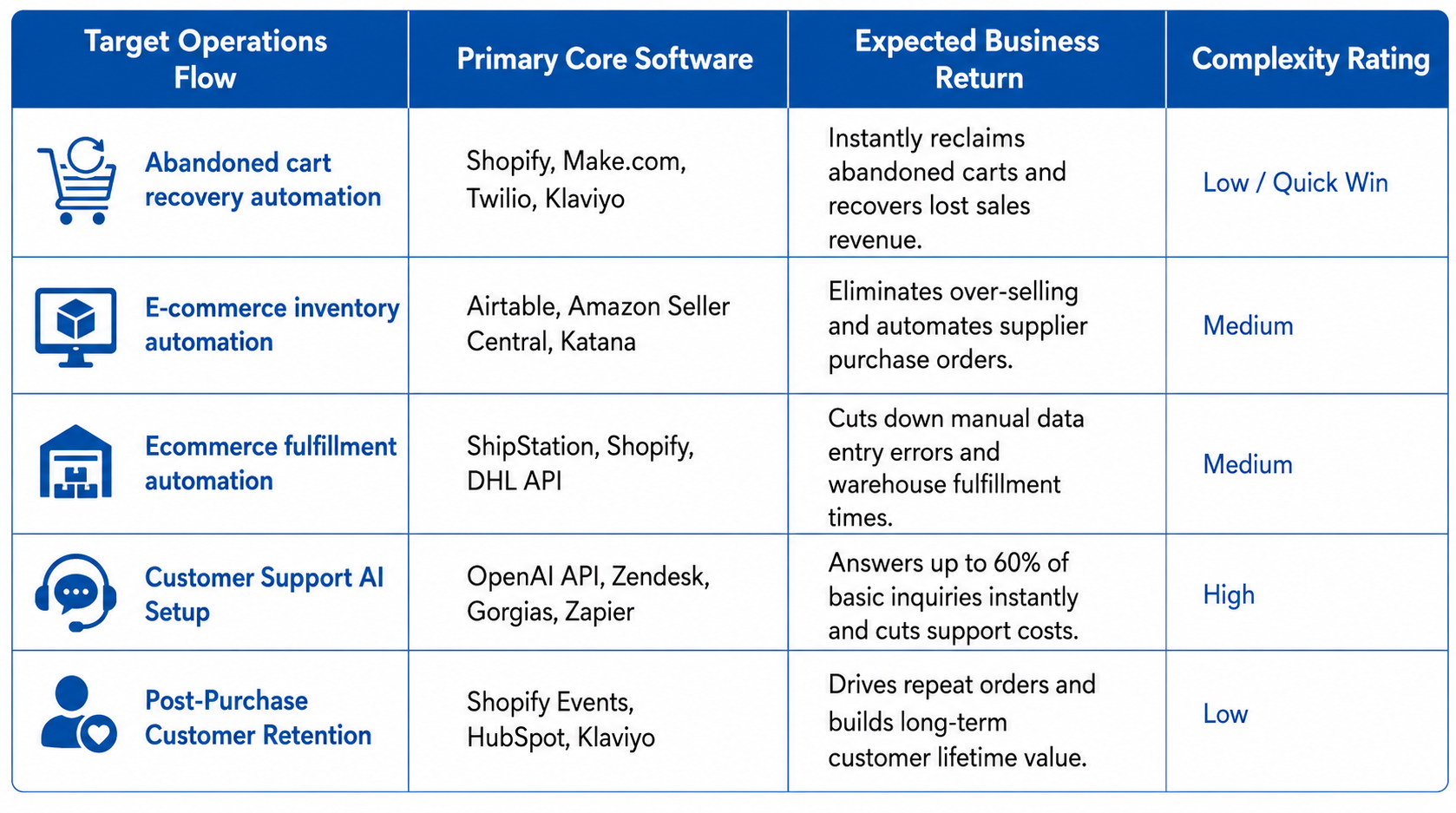
To help your operations team prioritize these technical updates, here is a quick overview of how these operational workflows compare:
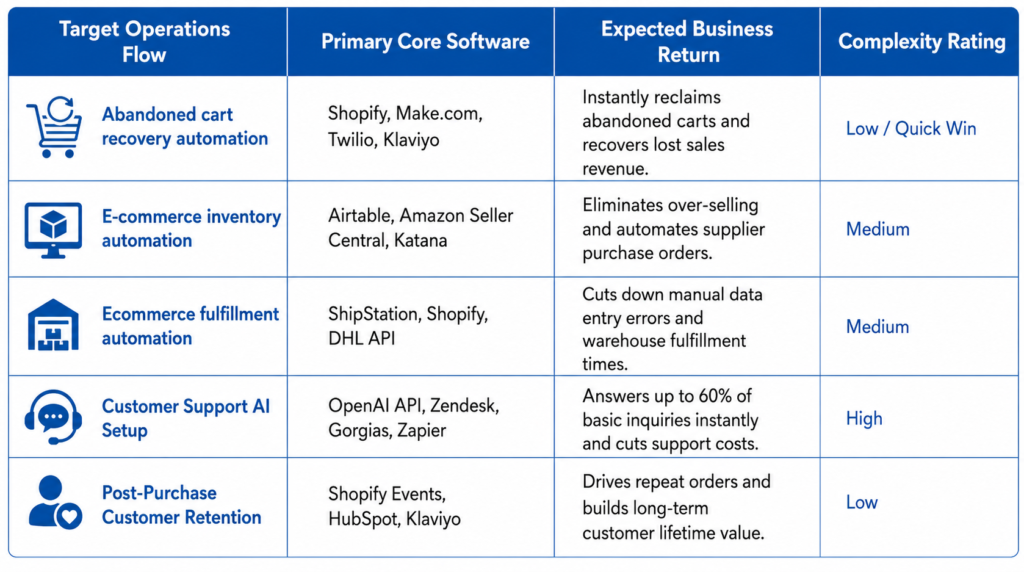
It does not take rebuilding your technology to achieve a series of first automated workflows and there is no more effective strategy than automating at first just one high impact workflow to make a rapid profit – one abandoned cart recovery automation. Once you get your first task removed by freeing up your manual input, it is simple to begin to increase in order to connect the internal technology and begin using a range of bespoke artificial intelligence based systems to handle your back end operations. Ready to move on from a store controlled using messy spreadsheets, a stack of copy and pasted documents, loops of manual activity and data entered by hand? Send an enquiry to an executive ai automation agency, Remote Minion AI and we’ll audit the systems you’re currently using to help remove operational friction and building out custom enterprise architecture designed for rapid brand scalability.

AI automation service from India. We help small & mid-size businesses eliminate repetitive work using no-code tools and AI — at 60% less cost.
Copyright © 2026 KHP Remote FTE Pvt Ltd. All rights reserved.